Author Archives: gregwun


Restorative Community Conversation on the Concept of Race
May 30, 2017 – Ali‘iolani Hale, Hawai’i Supreme Court
“The way to stop discrimination on the basis of race is to speak openly and candidly on the subject of race.”
~ Sonia Sotomayor, United States Supreme Court Justice, Schuette v. BAMN, dissent 2014

Background on organizer and the event
Hawai’i Friends of Restorative Justice (HFRJ) was incorporated in 1980 to develop alternatives for youth on probation with the Hawai’i state family court in Honolulu. Since then it has evolved to develop, provide, study, and publish research findings on public health, restorative justice, and solution-focused approaches to promote healing and peace to broad audiences. HFRJ has collaborated with many individuals and organizations including courts, prisons, law enforcement, schools, public housing communities, and a variety of non-profits and government agencies. Its work is referenced nationally and internationally, and it has both a global and local reach. Over 60 papers have been published about its projects and several film productions also feature HFRJ’s work.
In 2016, HFRJ began providing community conversations concerning justice issues affecting O‘ahu residents. In an effort to generate more community understanding and address racism, HFRJ collaborated with two state judicial organizations, the Center for Alternative Dispute Resolution, and the Judiciary History Center to provide a conversation held May 30, 2017 at Ali‘iolani Hale, the state Supreme Court. Thirty-nine people participated in large and small conversations concerning the “concept of race.” Individuals who participated ranged from judges, people who provide social programs, graduate students, lawyers, community advocates, feminists, and people on parole and formerly incarcerated. A list of the participants is attached.
Invitation to participate
People were individually emailed an invitation describing the event as:
This will be an engaging experience with you sharing in small groups your experiences concerning the concept of race, what it means, and how it has affected your life and community. You will also have the opportunity to consider and express how you would like the concept of race to be addressed by others.
People were invited to share the invitation with others who might be interested in attending. Those who said they could attend the event, were emailed the following information and instructions beforehand:
The dialogue will begin in a large circle with Chief Justice Mark Recktenwald opening it, and each of us quickly introducing ourselves. Then we will re-form into assigned groups of five. In each small group, one person will act as facilitator/timekeeper to ensure everyone has equal opportunity to express themselves.
The small groups will address: 1. How has the concept of race affected you? and time permitting: 2. How would you like people to view the concept of race?
To prepare for the dialogue please take a free Harvard Implicit Association Test (IAT) concerning race, skin-tone or an ethnic group https://implicit.harvard.edu/implicit/takeatest.html to learn something about any implicit racial biases you may have. Your survey results are confidential and will only be discussed at the dialogue if you want to. Here is a short New York Time 2016 article on implicit biases: https://www.nytimes.com/2016/10/07/upshot/were-all-a-little-biasedeven-if-we-dont-know-it.html?_r=0
Basically, we all have implicit biases. These are biases that we learn from our culture, which we may not be aware of and which may not concern race—we may be biased about age, religious beliefs/disbeliefs, people’s weight, sexual preferences, political parties, etc. Implicit biases exist regardless of our ethnic backgrounds, education, or economic status. Besides taking the survey on racial biases, you may also take additional surveys concerning many other areas as the Harvard IAT website provides.
The two hour dialogue is scheduled as:
25-30 minutes Chief Justice Recktenwald’s opening & introductions in large circle
60 minutes small groups
30 minutes large circle again with any concluding comments from each person (if 46 people attend as currently listed that would give each person about 40 seconds equal speaking time).
Large opening circle
Rich Turbin, Esq., HFRJ president, introduced Hawai’i Chief Justice Mark Recktenwald, who opened the large circle with all participants. Justice Recktenwald provided a short inspiring talk about the importance of racial equality in our country and community. The 39 participants then provided their names along with a brief description of their activities. The large circle took about 30 minutes total time.
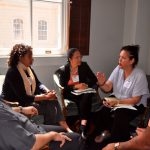
Small-facilitated circles
Eight people coming to the event, agreed to act as “informal facilitators” of one of the small circles. They were told: “You are mainly tasked with making sure everyone gets time to speak and no one takes up all the time (including you).” After the large circle, the 39 participants went to a pre-assigned small group with one of the facilitators. The small groups were chosen earlier to reflect participant diversity in sex, age and ethnic identification.

Sharing personal stories and generating more community cohesion
In the eight small groups, individuals shared their personal stories about race. Most of the small group facilitators prepared a short report on participants’ comments and many participants expressed how the event was for them during the large circle.
“Hawai’i is the best place to address racism. We are multicultural.” ~ small group participant
Comments of several groups indicated that growing up, some felt like “the other” because they appeared different from the majority, which could also be light skinned in Hawai‘i. How one’s race is viewed has the potential to create difficult feelings including alienation, not belonging, and being outside of the community.
One person noted that protection from racism could come from “safety in numbers” for those with a similar appearance. Some appreciated their resiliency: “Facing obstacles (discrimination, racism, judgment, oppression) based on race have made us stronger!”
Insufficient melting pot and the need to assist Micronesian people
Several participants noted that there is a tendency to view Hawai’i as a melting pot, with a successful multicultural population living in harmony. This concept is challenged by experiences including the over representation of Native Hawaiians in the justice and prison system. Many participants noted that currently Micronesian people are especially prone to suffer bias and discrimination in Hawai‘i. The observation was made that in Hawai’i, people are aware of bias hardships Micronesian people currently face because all ethnic groups have experienced prejudice at some point in Hawai’i. Several people voiced the hope that more people from Micronesia could attend future community conversations like this one.
Recognition of the importance of values
Appreciation of values was a consistent theme in the facilitator’s reports and expressed in the large group.
The value of cooperation, which was described as “fundamental in Hawaiian culture,” rather than competition, was discussed in a small group, and also mentioned in the large circle.
Some noted a preference for living in Hawai’i because there is more acceptance for ethnic diversity in the community.
Hopeful messages
Despite the covert, overt, internal and external discrimination and bias, and problems of the racial, economic, and social class intersections, the circles and conversations provided the opportunity to express and to hear about hope and optimism.
In one small group a participant discussed a cooking program that its agency offers. The participants cook food from different cultures, which helps them recognize and value their differences.
“We had a very good discussion on race that was meaningful and hopeful.” ~ small group participant
The potential of bridge kids was discussed in the large circle: “There is value in recognizing that children of multiple ethnicities are bridge kids and can work toward closing the gaps that separate us based on race.”
Participants indicated that finding ways to expose individuals, especially children and youth, to experiences with people of different backgrounds and appearance is important. Diversity helps eliminate bias and discrimination.
After one hour of the small groups discussing race, about 25 minutes remained for a large circle to close the event. Participants in the large circle shared quickly how the conversation was for them. Comments were all positive.
Large closing circle and concluding comments
It was noted that people in conversations both “laughed and cried” about the subject of race and the stories shared during the conversations.
A suggestion that a participant made, which others noted they too would like to see happen, is that each individual in our community take “personal responsibility” for developing insight, healing and love for themselves, to help others.
One person stated:
I think the exercise went extremely well, better than planned or expected. This was deeply personal to each one in the room and their stories were powerful and empowering. Most importantly the discussion motivated each one to move forward in action. The sharing at the end was a great culminating activity so that the idea of fighting racism was a shared value among the participants and they left with many ideas from a diverse group, including white participants.
Future conversations
It is recognized that more time is needed to discuss this topic, including explore solutions, and that the May 30th conversations only “scratched the surface.”
Another dialogue is planned for early November, which participants will be invited to attend.
Lorenn Walker, JD, MPH
Director, Hawai‘i Friends of Restorative Justice
Revised June 8, 2017
____________________
Participants of the conversations about race at Ali‘iolani Hale May 30, 2017
- Leslie Kobayashi – Federal Judge
- William Domingo – Hawai’i State District Court Judge
- Jackie Young – Chair Judicial Selection Commission
- Rich Turbin, Esq, President Hawai’i Friends of Restorative Justice
- Tanya Ng – Advocate for Imprisoned Women
- William Harris, Esq.
- Tim Ho, State Public Defender
- Sandra Simms, Retired Circuit Court Judge
- Kat Brady, Director Community Alliance on Prisons
- Henry Curtis, Director Life of the Land
- Cheri Tarutani, UH Social Work Professor
- Nanci Kreidman, CEO Domestic Violence Action Center
- Nancy Aleck, Retired Director Hawai’i People’s Fund
- Lea Jimenez, PhD., Counseling Psychology, Co-Founder CompassBlu
- Tammy Martin, UH Social Work Phd Student
- Talia Cardines, Manager Fernhurst YWCA
- Toni Bisson, Director Pu’a Foundation
- Erendira Aldana, UH Doctoral student Community and Cultural Psychology Program
- Sanna King, UH Doctoral Student in Sociology
- Robyn Pfhal, Esq.
- Lisa Jensen – Treasurer Hawai’i Friends of Restorative Justice
- De Mont Conner, Legal Assistant & Community Activist
- Momi Conner, Community Activist
- Ana Kaleopaa, MBT MSW Candidate 2017
- Michael Knott, State Parole Officer
- Madonna Perez, Legal Assistant Legal Aid Society of Hawai’i
- Matt Taufetee, Director First Lap
- Merton Chinen, Director Office of Youth Services
- Keahe Davis, Judiciary History Center
- Chas Williams, Director WorkNet Hawai‘i
- Cecilia Chang, Director Center for Alternative Dispute Resolution
- Innocenta Sound-Kikku, Chuukese Community Advocate
- Sophia Henager, AmeriCorps, Asset Protection Unit, Legal Aid Society of Hawai’i (LASH)
- Kara Doles, LASH
- Jacklyne Moses, LASH Fair Housing Outreach Specialist
- Marissa Okazaki, LASH
- Allison Jacobs, JD, Legislative Assistant & Community Advocate
- John Martin, Reverend
- Lorenn Walker, Director HFRJ
Our Previous RJ Circle April, 13, 2016
We held a circle Restorative Justice circle in April, 13, 2016. Read more here…
8TH ANNUAL PAROLE COMPLETION CELEBRATION HAWAI’I, ALI’IOLANI HALE, SUPREME COURT NOVEMBER 9, 2016.






2016 Parolee Celebration
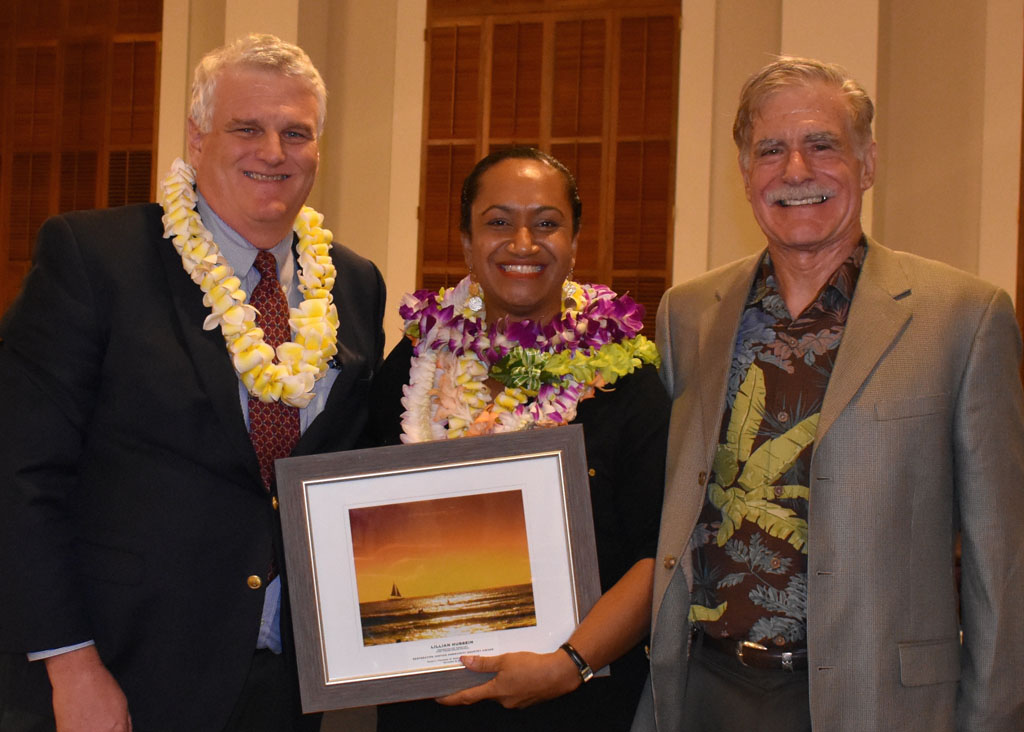
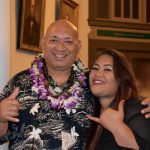
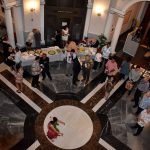
See all the photos from the celebration honoring the hard work of people completing parole and those who helped them.
Restorative Justice: Giving Victims a Voice
More Pictures from Angela Davis’ Visit
Angela Davis with Justice Sabrina McKenna and with U.H. law school dean Avi Soifer at Hawaii Friend’s President Rich Turbin’s house on April 28, 2016.


.
Restorative Justice Circle Apr. 13, 2016

On April 13, 2016 a gathering of those interested in restorative justice was held at the Hawaii Supreme Court. Here is the summary followed by more photos below.
JUSTICE IN HAWAI‘I COMMUNITY CIRCLE SUMMARY
Restorative Justice (R J) values being accountable and taking responsibility, being respectful, and repairing harm and relationships as possible. R J asks:
Who is responsible? Who was affected? How were they affected? What can be done to repair the harm?
On April 13, 2-16 Hawai‘i Friends of Restorative Justice convened a ninety-minute circle event to consider how restorative justice might be used in Hawai‘i.
The circle was held at Ali‘iolani Hale, the Hawai‘i Supreme Court, with 35 people including Angela Davis, iconic scholar and justice advocate, and Mark E. Recktenwald,
Chief Justice state of Hawai‘i. Participants included former justice system consumers including parolees, people who work in the justice system, students, academics, and community activists whose names are attached.
In one large circle, the 35 participants shared what they found hopeful about justice in Hawai’i.
While expressing a variety of hopes, the following challenges to justice were expressed:
- New prison construction costing $1.5 – $2 billion sought by the state without plans to reduce the approximately 6000 incarcerated
- New privatized prison – no oversight, no referendum, no transparency – lots of lawyer lobbyists work for Corrections Corporation of America in Hawai‘i
- Saguaro Prison case – Hawai‘i prisoners on mainland impedes rehabilitation & harms families and communities
- Prison can further criminalize non-violent incarcerated people
After the large circle, small circles of 5 – 7 people, which most of the participants engaged, discussed: What could you do to further your hope for justice in Hawai‘i, and how RJ might used?
The small circles consistently found the following solutions:
ORGANIZE: Intentional regular meetings of interested parties that plan, organize, asset map, and carry out agreed upon strategies to move the justice system from one that is punitive in nature, to restorative. Examples of restorative approaches: innovative, therapeutic courts, indigenous approaches, alternative sentencing, mental health and substance abuse treatment
TRAIN: all players in the system (teachers of criminal justice, judges, police, medical professionals, lawyers, clerks, bailiffs, parole officers), on RJ language, on historical trauma, other RJ principles. Engage youth in civics and peace education, promote prevention strategies.
COMMUNICATE: build more community communication mechanisms, circles, build personal connections, tell your RJ story, post on social and other media, share
LEGISLATURE: educate legislators, invite them into circles, make case for lower costs associated with RJ strategies One participant summarized the value of RJ: “restorative justice circles promote connection – circles create sacred spaces – circles help people heal.
Hawai‘i Friends of Restorative Justice plans to convene another circle event before the end of the year, possibly in October 2016.
Participants at 4.13.16 community circle on restorative justice in Hawai‘i:
- Angela Davis, professor
- Mark Recktenwald, Hawai’i chief justice
- Leslie Kobayashi, federal district court judge
- Bert Matsuoka, Hawai‘i parole board chair
- Ken Lawson, Hawai‘i innocence project director
- Jackie Young, Former legislator & cancer assn. director
- Momi Cazimero, graphic artist
- Amy Agbiami, PhD, Univeristy of Hawai‘i diversity director
- Rich Turbin, Esq. & Hawai’i Friends president
- Roger Epstein, Esq. & Hawai‘i Friends vice president
- Faye Kennedy Daly, sister Florynce Kennedy who defended Dr. Davis 1970s)
- Nancy Alec, Hawai’i People’s Fund foundation director
- Sharon Hicks, Author, administrator of numerous non-profits & Hicks Homes
- Merton Chenin, Hawai‘i office youth services director
- De mont Connor, paralegal & community activist
- Momi Connor, community activist Leeward Coast
- Sandra Simms, retired state court judge
- Tim Ho, Hawai‘ chief deputy public defender
- William (Bill) Harrison, Esq.
- Patty Lyons, founder Consuelo foundation
- Sonny Ganaden, Esq. & journalist
- Rai St. Chu, Esq.
- Henry Curtis, Life of the Land director
- Ian Crabbe, electrician
- Matt Taufeete, pastor & half way house director
- Allison Jacobs, Hawai‘i legislative minority researcher
- Toni Bissen, Esq., Pu’a foundation, founder & director
- Patricia Boone*, 3L Northwestern University extern Judge Steven Alm
- LA Giles*, MSW student & Hawai‘i Friends intern 2015 – 2016
- Cheri Tarutani*, Hawai’i Friends board member & professor
- Kat Brady*, Community Alliance on Prisons,
- Melody Kubo*, state judiciary
- Erin Ka‘ahea Gross, MSW student and 2014-2015 Hawai’i Friends intern
- Dawn Slaten*, Esq. & Hawai’i Friends facilitator
- Lorenn Walker, Hawai‘i Friends director
Mahalo Robyn Pfhal, Esq. & photographer and Lisa Jensen, conflict management consultant for help with photos and organizing.
* Mahalo for facilitating small circles